
Should I be worried about certain ingredients in products?
Calling an ingredient a chemical can sometimes lead to concern yet the two terms can be used interchangeably. Absolutely everything is made up of chemicals as they are the building blocks of all substances, both natural and synthetic (man-made). We tend to use the term ingredient for the chemicals that make up all different types of products, from cosmetics to cakes. We could equally call the many substances that make up the human body its 'ingredients'.
This means that nothing can be 'ingredient-free' and everything is '100% ingredients', and equally nothing can be 'chemical-free' as everything is '100% chemical'.
Since there are no 'chemical-free' products, the important question is whether the products you choose and all their ingredients are safe. You can rest assured that all cosmetic products are developed with safety at the forefront and are subject to strict UK legislation which requires a robust safety assessment for each cosmetic product before they are available for purchase.
Safety is the number one priority of the cosmetics industry. ALL cosmetic products placed on the market in the UK, whether in-store or online, are regulated by specific strict legislation to protect those who use cosmetics.
There are three layers to the safety assurance process:
- UK legislation requires cosmetics to be safe.
- The professional Safety Assessor personally signs an assessment specific to that product to say the cosmetic product is safe.
- There is a formal mechanism to monitor the safety of cosmetics once placed on the market involving companies and authorities.
The image below from Sense About Science gives us some perspective on some ingredients. While they may sound scary, many actually occur naturally in everyday foods like pears and apples.
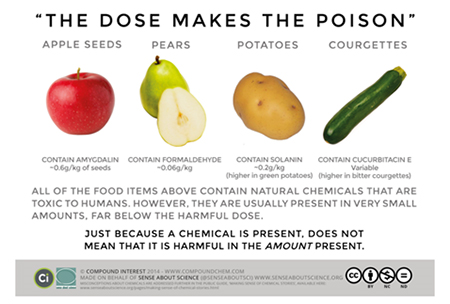
Source: Sense About Science - Making Sense of Chemical Stories
Should I look for products that say "chemical-free"?
No! Since absolutely everything is made from chemicals, from cosmetics, to water, to the human body, there is no such thing as a 'chemical-free' product and you shouldn't be alarmed by the term 'chemical'. We could equally use the term 'ingredient'.
To help to address the confusion surrounding terms like 'chemical-free', CTPA works closely with cosmetic and personal care product manufacturers to explain why using terms like 'chemical-free' on product advertising or packaging is misleading.
Here, Dr Chris Flower, a Chartered Biologist and Toxicologist, explains how there is no such thing as 'chemical-free'.
Since there are no 'chemical-free' products, the important question is whether the products you choose are safe. You can rest assured that all products are developed with safety at the forefront and are subject to strict UK legislation which requires a robust safety assessment for each cosmetic product before they are available to purchase, whether in-store or online.
Are chemicals safe in the UK post-Brexit?
Chemicals in the EU are regulated under the Registration, Evaluation and Authorisation of Chemicals (REACH) Regulation. Its aim is to ensure a high level of protection for human health in the workplace and the environment from the risks that can be posed by chemicals. If the risk cannot be managed, authorities can ban or restrict the use of substances as appropriate.
Chemicals in Great Britain are regulated under a new version of REACH, called UK REACH. UK REACH operates in a very similar way to EU REACH.
In addition to REACH, chemicals that are used as cosmetic ingredients are also covered by strict safety requirements under the UK Cosmetic Regulation, which also covers the safety of finished cosmetic products. This law is based on the EU Cosmetic Products Regulation, which was the previous cosmetics law in the UK. Safety standards for cosmetics and their ingredients in the UK remain as rigorously controlled under specific UK legislations as under the previous EU law.
Are 'free-from' products safer than products that contain certain ingredients?
Some products claim to be free from specific ingredients or types of ingredients. Whilst this might help those consumers who wish to avoid that ingredient, it does lead to some negative effects. , There is the risk that people may look for 'free from' claims instead of looking at the ingredient list if they are looking to avoid a certain ingredient; for example, due to allergy. However, the ingredient list is the only comprehensive source of information as to what is in the product that can be relied upon to be present on every product. The ingredient list’s primary purpose is to enable people who have been diagnosed as allergic to particular ingredients to avoid products which contain them.
Of equal concern is that people may come to see 'free from' as implying there is a safety issue with the ingredient in question and that 'free from' products are somehow safer. This is wrong. All ingredients used in cosmetic products must be safe. If there were a safety issue with any ingredient, it would be banned for all cosmetics equally.
Are products made from natural ingredients safer than those made with synthetic ingredients?
The term "natural" may evokes feelings of safety and purity. However, not all natural substances are harmless. In fact, nature is responsible for producing some of the most potent and deadly poisons known to science—from the venom of certain snakes and spiders to toxic plants like deadly nightshade and hemlock. Just because something is derived from nature doesn’t automatically make it safe for human use or consumption.
The law requires that the safety of all ingredients is assessed when developing a product, irrespective of their source, and their use in cosmetic products must be safe. In fact, whether ingredients are natural or synthetic has no bearing whatsoever on how safe they are. Also, the name of the ingredient, whether long and complex or short and memorable, has no bearing on how safe it is either. What is important is the properties of the ingredient, how much of it is used and in what way.
We should also remember that anything has the potential to be harmful if used in the wrong way, even water, oxygen, salt or Vitamin A for example; too much or too little can cause severe harm in each case.
We can feel confident that all cosmetic products found on the shelves are safe for these reasons:
- Stringent UK laws require all cosmetic products to be safe.
- Each one must undergo a rigorous safety assessment by appropriately qualified and authorised scientists.
- There is a formal mechanism to monitor the safety of cosmetics once placed on the market involving companies and authorities.
Are products made from natural or organic ingredients better for the environment than those made from synthetic ingredients?
Natural and organic ingredients are not always better for the environment than synthetic ones. In fact, the source of an ingredient, whether it is from nature or from a laboratory, has no bearing on whether it is better or worse for the environment. What is important is the way in which the ingredient is produced and whether this is sustainable.
Although nature can provide inspiration as a source of new ingredients for cosmetic and personal care products, natural resources are not always sustainable. For example, the excessive harvesting of plants from the wild can lead to a reduction in their numbers in nature or to a loss of natural habitat and biodiversity.
Scientists can produce synthetic replicas of many natural ingredients from oils to fragrances. These are the same in every way as their natural counterparts and behave the same when put on the skin. In fact, synthetic ingredients can often be purer than natural ones, since they are produced under very strictly controlled conditions.
Many people choose to support the principles of 'organic' as a lifestyle choice. The industry has developed products and ingredients to suit that choice. However, this does not mean that all other ingredients are automatically harmful to the environment.
Are products that contain fewer ingredients better for your health than those with more ingredients?
The number of ingredients present in a product has no bearing whatsoever on its safety.
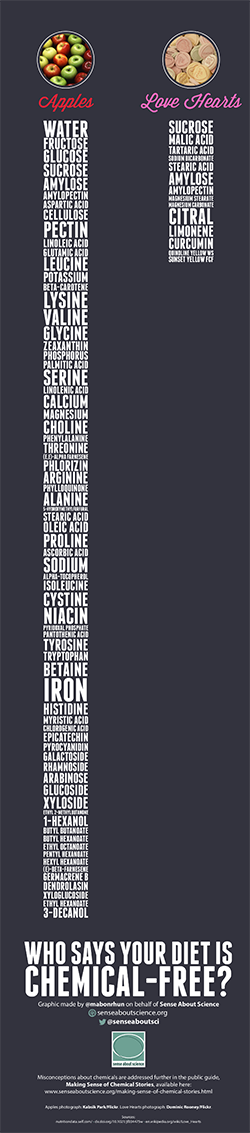
Cosmetic and personal care products are very complicated to make and they often have a long list of ingredients to get them just right. Each ingredient within that list will have a specific role to play, from making the product work effectively, to making it smell and feel nice, to making it last for a satisfactory amount of time.
Each one of these, individually and in combination, will have been rigorously assessed for safety before placing the product on the market. The safety assessor uses detailed technical information about each ingredient along with their knowledge and skill that comes from many years of training to assess the safety of the final product.
By law, all ingredients added to a cosmetic product must be labelled on the pack. These ingredients must be listed in descending order of weight at the time they are added to the cosmetic product. This list is extremely important for people who have been diagnosed with an allergy, so that they can avoid the ingredients to which they are allergic.
Can ingredients from products build up in the body over time to reach unsafe levels?
A common concern is that ingredients in our everyday products, such as cosmetics and personal care products, might stay in our body and build up over time (possibly to reach unsafe levels). Scientists call this process "bioaccumulation". The potential for bioaccumulation is one of the factors that scientists look for when assessing whether an ingredient is safe to use or not, so we can be confident that the products we use are indeed safe.
Modern technology can now detect the tiniest traces of chemicals in the human body, even down to levels as low as parts per billion. To put this in perspective, one part per billion is equivalent to one second in thirty years!
Importantly, detecting the presence of an ingredient in the body is not evidence of bioaccumulation or of any harm being done by that ingredient. It simply shows that the person has come into contact with that ingredient at some point. In fact, the ingredient may well be on its way out of the body. The body is an amazing thing and eliminates effectively all the substances that it doesn't need; so, if the ingredient in question isn't required by the body, the chances are it won't be around for long. in any case, the cosmetic safety assessment will take into account the potential of the ingredient to be absorbed and any potential effects, to ensure there is no risk of harm.
What should I do if I have an allergic reaction to a certain ingredient?
The majority of people use cosmetic products without any problems. However a small number of people may have a reaction to certain ingredients.
If you have had a reaction:
- See your GP for further information. They may refer you to a specialist such as a dermatologist to determine the type of reaction and the possible cause.
- Contact the manufacturer to let them know you have had a reaction to their product. They will be able to advise you further.
- If it is an allergic reaction, once the ingredient you are allergic to has been identified, you will be able to avoid it by checking the ingredient list on cosmetic product packaging. Ingredients are listed with the same names across Europe, and increasingly elsewhere in the world, so you should be able to identify your allergen even when travelling.
If you are colouring your hair, always perform an Allergy Alert Test every time you colour your hair when instructed by the packaging.
Can ingredients in everyday products be more easily absorbed through a child's skin than an adult's skin, with greater risk or harm?
No. In fact, babies are born with skin which is very nearly complete in its barrier function and this further matures within the first two to four weeks after birth, providing an effective barrier to external substances. Although baby skin may be physically more sensitive than adult skin, and thus requires gentle handling, from the point of view of being able to keep out unwanted substances, baby skin is an effective barrier.
Baby skin is more delicate than that of adults and can be damaged by coarse fabrics or rough towels, for example. This is partly because baby skin is slightly thinner than adult skin (about 20 to 30%). It is also because skin responds to the environment and babies are making the transition from life in the womb to life in the outside world, and therefore experiencing it for the first time. Baby skin also has a higher surface pH (a scientific measure of acid or alkaline).
Personal care products made for babies and infants are formulated to take these factors into account; for example, they use milder cleansers, low levels of fragrance and carefully control the pH to ensure compatibility with the skin. Also, there is an enhanced safety assessment legally required for all cosmetic products intended for use on children under three years of age.
Generally bathing a baby in water only is the recommendation for the first two to four weeks of life but after this point, it is safe to use personal care products which are intended to be used on babies and infants. NHS Choices has advice on washing and bathing your baby.
Can exposure to chemicals in cosmetics during pregnancy harm the unborn child?
In the case of cosmetics and personal care products, all products must be rigorously assessed for safety by appropriately qualified and authorised scientists before they may be placed on the market.
The safety assessment must take into account all the different situations and conditions in which the products are likely to be used, including their use by women during pregnancy. If any risks are identified, the law requires that product makers must put clear warnings on the product labels. In fact, since a woman may not know from the outset she is pregnant, manufacturers would not market any cosmetic that could be a risk during pregnancy.
Always ensure you read the label and follow its advice - then you can feel confident about enjoying your products safely.
What is the role of preservatives in making a cosmetic product safety for use?
Preservatives play an essential role in keeping the consumer safe against spoilage and contamination of their cosmetics products by micro-organisms during storage and also during continued use. In short, they make our products last.
There are very few ingredients that have the rare quality of being able to work across a variety of products in order to keep them safe and microbe-free.
There is a specific list of preservatives that are allowed to be used in cosmetic products within the UK Cosmetics Regulation.
How can I be sure the products I am using are safe?
It's not just ingredients that are considered when a product is being designed and manufactured.
A whole team of scientists develop, manufacture and market each cosmetic product. From concept to final product the sequence will include biological research into specialist ingredients, the development of the formulation, efficacy testing, scaling up to manufacturing from laboratory development, packaging, further efficacy testing, safety assurance and regulatory compliance. Each and every step involves many different scientific disciplines. No cosmetic products in the UK are tested on animals.
A key step is the safety assessment. The safety assessor signs the product safety report in a personal capacity. That person must be appropriately qualified and experienced to do so, and the required qualifications are listed in the UK Cosmetics Regulation. Without the sign-off from the safety assessor, the product cannot be placed on the market.