
What gives our hair its natural colour?
Hair is given its natural colour by colour pigments produced in the hair root called "melanin pigments". There are two types of melanin pigments that determine hair colour: "eumelanins" which create the darker shades (ranging from reddish-brown to black) and "pheomelanin" which create the lighter shades (pale yellow to red). The hair's natural colour is determined by the proportions of these different pigments.
"Grey" hair is an optical illusion created by a mixture of white (non-pigmented) and pigmented hairs.
White hair is created when melanin pigments are no longer present in the cells that make up the hair either melanin production stops or the melanin is unable to be transmitted into the hair cells.
What are the different types of hair dye?
There are three basic categories of hair dye, depending on the duration of effect produced: temporary, semi-permanent and permanent.
Temporary hair dye
Temporary hair dye modifies the colour of the hair temporarily and is readily removed by washing. Temporary hair dye products, also known as colorants, tend to be ready-to-use (no pre-mixing) and contain "direct" colorants. These colorant molecules are unable to penetrate the hair fibre and settle on the hair surface. The combination of these molecules with the natural hair colour provides the new shade.
Semi-permanent hair dyes
Semi-permanent hair dyes are made of colorant molecules that are able to penetrate the hair. These colorants settle on and within the scales of the cuticle, becoming established around the cortex without modifying the hair's natural melanin. However, since these molecules are also not bound to the hair protein, the colour gradually fades with washing. The colour normally stays in for up to 6-8 washes.
Oxidative hair dyes
Oxidative hair dyes are easy to recognise. Normally the pack contains at least two components which have to be mixed together immediately prior to use. Oxidative hair colorants change the natural hair pigments and give the hair depending on the formulation, either "tone-on-tone" colour (also referred to as "demi-permanents") or "permanent", lasting colour.
Permanent dyes
Permanent dyes cannot be washed out and this is the more traditional way of permanently changing hair colour around the world. They produce an effect that is resistant to washing and they provide long term colour changes, ranging from subtle to dramatic, as well as excellent coverage of "grey" hair.
The two components that are mixed usually include a tube that will contain the colorant precursors and an alkaline agent (the 'colorant') and a bottle that contains hydrogen peroxide (the 'developer').
How do permanent oxidation hair dyes work?
The effect of each oxidative dye is based on the following components: an alkalising agent - usually ammonia - and oxidation colouring agents. The alkaline agent has the effect of opening the outer hair layer so that colouring and oxidising agents can penetrate into the hair shaft more easily.
The starting materials for developing the new colour are called colour precursors which are very small, colourless molecules that only develop their own colour nuance once they react together inside the hair.
The oxidising agent, usually hydrogen peroxide, is mixed with the colour precursors prior to application. Oxygen is released by the reaction between the alkaline agent and the oxidising product. It triggers the actual colour-changing reaction. Large, coloured molecules are formed within the hair's cortex which are resistant to being washed out of the hair. Simultaneously, the oxygen released will lighten the natural melanin pigment in the hair so that the new colour can be seen, effectively replacing the hair's natural colour.
"Tone-on-tone" colorants also include an oxidation step (for example, mixing with peroxide) but they do not cause a significant lightening of the hair's natural melanin pigment. Tone-on-tones traditionally enhance or deepen the natural hair colour. The final colour is quite durable and will gradually wash out after approximately 28 shampoos.
Hair colouring is one of the oldest cosmetic treatments and one of the most difficult. The dye chemistry and formulation is very challenging. Innovations have previously occurred in three major areas.
Firstly, in the form of the product. In order to get good mixing of the dyes with the developer, the developer and tint need to be thin. However, thin products simply run off the hair. To overcome this, gel networks form within the product upon mixing to turn thinner products into a thick and easy to apply final form.
The second area is in ‘chelants’. Chelants are chemical compounds which seek out and trap tiny amounts of metals. These are normally added to stabilise hydrogen peroxide. However, hair also contains metals such as copper that penetrate from tap water. In turn, these react with hydrogen peroxide to form free radicals that can damage the hair. By choosing special chelants that inactivate copper it is possible to achieve increased hair protection.
The third is in 'conditioning'. In terms of the colorant product itself, innovative conditioning polymers have been incorporated into some hair colorant creams, which are able to penetrate into the cortex of the hair and help reinforce hair weakened by the colouring process.
Furthermore, new formulations for "in box" conditioners are able to give longer term durable conditioning to coloured hair. When hair is coloured with permanent colours a unique fatty acid is removed from the hair surface. This changes the surface from being hydrophobic to hydrophilic and in turn this changes the interaction of uncharged conditioning molecules with the hair surface. As a result, new conditioning molecules have been designed that match the surface energy of the hair fibre to help them deposit and spread on the surface.
Hair dye safety
For millions of us, using hair dye is an important part of our self-care routine, helping to boost our confidence, cover grey, or try out new looks. While hair dyes are generally safe to enjoy and subject to strict safety regulation, some people can develop an allergic reaction to the ingredients they contain.
Most commonly, people develop allergies to an ingredient called para-phenylenediamine (PPD) which helps to give your hair a darker colour. Understanding how these reactions happen, and how to prevent them, is key to staying safe while enjoying hair colour.
How common are hair dye allergies?
True allergic reactions to hair dye are very rare - around 5% of people1 are thought to be allergic to hair dye ingredients. That’s far less frequent than many common allergies, such as those to nuts or pollen.
That said, an allergy can develop over time, even if you’ve used the same product for years without an issue. This is why it's essential to test for allergic sensitivity before every use.
What causes hair dye allergies?
The main culprit in most allergic reactions is PPD, a chemical used in many permanent and semi-permanent hair dyes. PPD helps create long-lasting, natural-looking results, especially in darker shades. It's safe to use in hair products when applied correctly and under the conditions regulated by UK and EU laws.
However, PPD can cause allergic reactions in some people. It’s also found in some illegal and unregulated products, like black henna tattoos, which can contain dangerously high concentrations of PPD and are applied directly to your skin. Using black henna tattoos can significantly increase your risk of developing a PPD allergy. Download our factsheet on 'black henna' temporary tattoos.
Recognising an allergic reaction
An allergic reaction can occur in two ways:
- Immediate reactions, which show up within minutes and may include symptoms like itching, swelling, redness, or breathing difficulty.
- Delayed reactions, which are more common with hair dye, usually appear 24 to 48 hours later and may involve redness, rash, itching, or flaking skin around the scalp, face, or neck.
In rare cases, a severe allergic reaction (anaphylaxis) can occur and requires urgent medical attention.
What is an Allergy Alert Test?
Important safety instructions are provided with hair dyes, both on the outer packaging on instruction leaflets contained inside the pack. These warnings alert us to the possibility of allergic reactions when we dye our hair and that these reactions, although rare, may be severe. The instructions emphasise an Allergy Alert Test must be carried out. This must be carried out for both home and salon hair dyes.
Different manufacturers and salons may recommend slightly different ways of doing the Allergy Alert Test, so always read the instructions carefully.
Find more information on hair dye allergy and how to carry out Allergy Alert Tests.
Why the Allergy Alert Test is essential
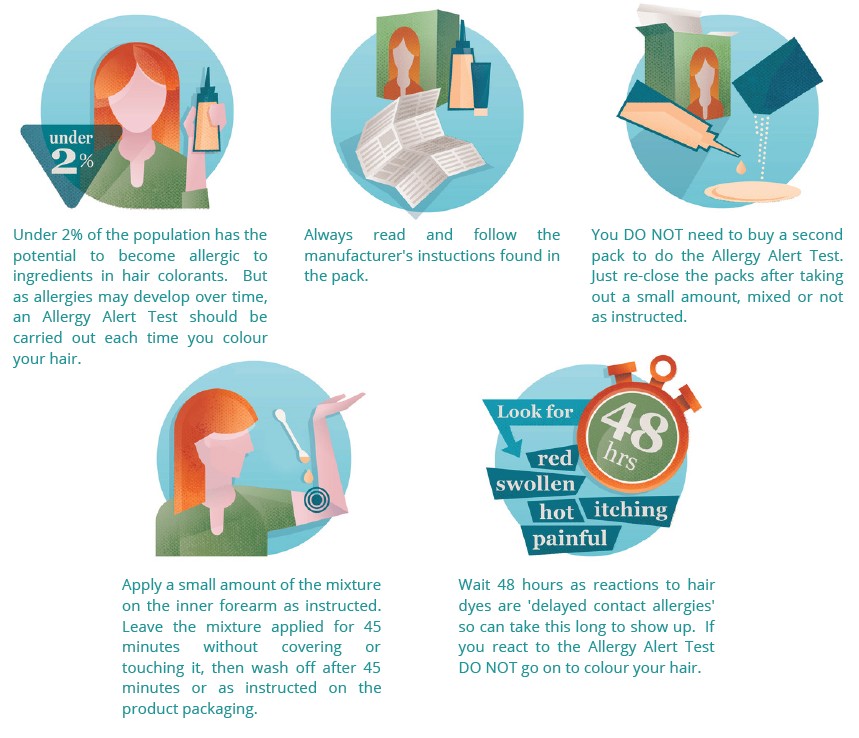
Before using any hair dye product -whether at home or at a salon - you should always carry out an Allergy Alert Test (also known as a patch test) at least 48 hours before applying the dye.
Here’s how to do it:
- Mix a small amount of dye as directed.
- Apply a dab to a discreet patch of skin (the inner forearm is usually recommended).
- Wait 48 hours without washing the area.
If you experience any irritation, redness, itching, or swelling, do not proceed with the hair dye. Instead, consult your GP or a dermatologist. Even if you’ve used the same product before, the test should be repeated every time. Allergic sensitivities can develop gradually and unpredictably.
Distinguishing between an irritation and an allergy
It’s important to note that not all negative reactions to hair dye are allergic. Some may be irritant reactions, caused by factors like prolonged skin contact, product build-up, or improper application. These reactions often resolve quickly once the product is removed.
True allergies involve the immune system and tend to persist or worsen with each exposure.
What to do if you react
If you have a reaction, even a mild one, stop using the product immediately. Wash the affected area gently with lukewarm water and avoid any further exposure.
In mild cases, symptoms may subside on their own. But for stronger or persistent reactions, especially those affecting your breathing, eyes, or face, seek medical advice promptly. You may be referred for professional patch testing to identify which specific ingredients caused the issue. From that point on, you should avoid all products containing PPD or related chemicals.
Tips for colouring hair safely
To minimise your risk and enjoy colouring safely, follow these essential tips:
- Always read the label: Hair dyes in the UK and EU must list ingredients using standard INCI names. Look for p-phenylenediamine (PPD) or a warning that says “Contains phenylenediamines.”
- Do the Allergy Alert Test 48 hours before each application, even with familiar brands.
- Avoid black henna tattoos: These often contain high concentrations of PPD and can trigger long-lasting allergies.
- Follow usage instructions exactly: Do not leave dye on longer than directed, and always wear gloves when applying.
Allergic reactions to hair dye are uncommon, but not impossible. Fortunately, by taking a few simple precautions, most importantly, performing a patch test, you can dramatically reduce the risk and continue to enjoy hair colouring safely.
If you’ve ever had a reaction or want to avoid PPD altogether, there are PPD-free and low-allergy options available on the market. Ask your stylist or dermatologist for recommendations tailored to your needs.
Find more information on allergies to cosmetics and personal care products.
1 Søsted, Heidi, et al. "Contact allergy to common ingredients in hair dyes." Contact Dermatitis 69.1 (2013): 32-39.