

-
What is the difference between UVA, UVB and UVC?
-
How do sunscreens work?
-
What are absorber filters (or organic filters)?
-
What are reflector filters (mineral or inorganic filters)?
-
Organic and mineral sunscreens - Is one better than the other?
-
What is SPF?
-
The science behind SPF
-
How do I know I am protected against UVA?
What is the difference between UVA, UVB and UVC?
- Ultraviolet (UV) A, B and C rays form part of sunlight. They are all related but are all slightly different and so have different effects on the skin.
- Most of the damage to our skin from the sun comes from UVA and B rays.
- UVC rays are blocked by the ozone layer so they don’t reach us.
- UVB rays penetrate the outer skin layer. They can damage the cells, causing the skin to become inflamed or sunburnt.
- UVA rays penetrate more deeply causing direct damage to the skin's supporting tissues, contributing to visible skin ageing.
- Both UVA and UVB rays are attributed to causing skin cancers of several kinds.
How do sunscreens work?
Sunscreen is a topically applied product that helps protect our skin from the sun. Sunscreens are also commonly called sun protection products or sun cream.
The key ingredients of sunscreens are UV filters. Their job is to help cut down the amount of ultraviolet (UV) rays reaching the skin.
They typically fall into two main categories:
- synthetic or organic filters, which absorb UV light; and
- mineral or inorganic filters, such as titanium dioxide, which mainly reflect UV light.
Because different UV filters tend to be effective against different wavelengths of UV, most sun protection products include filters for both UVA and UVB. This means they provide a broad spectrum of protection across the whole range of UV rays. Consequently, there are two different types of UV filter and these are: absorber filters and reflector filters.
What are absorber filters (or organic filters)?
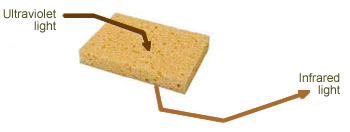
Absorber type UV filters work by absorbing ultraviolet rays much like a sponge soaks up water. Each tiny sunscreen 'sponge' soaks up ultraviolet rays, and then releases it back out after converting it into lower energy rays.
What are reflector filters (mineral or inorganic filters)?
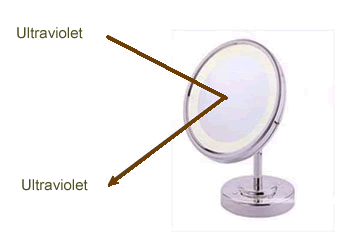
Unlike the absorber-type UV filters, reflectors tend to be less specific about the type of UV rays they reflect and tend to protect against both UVA and UVB. These sun filters act in a different way. Instead of soaking up the UV rays in the way that the absorber sun filters do, these materials reflect and scatter the UV rays away from the skin without changing it to anything else. They can be thought of as thousands of tiny mirrors each reflecting UV rays away from the skin.
Organic and mineral sunscreens - Is one better than the other?
No - they just work in different ways.
The most commonly used UV filters are the absorbers because these are more efficient (you get more sun protection for the same amount of ingredient). However they are often supplemented with reflectors.
Some people with sensitive skins or certain allergies may prefer a product with less absorber-type (organic) filters. In order to ensure that the product still provides the required amount of UV-protection, the absorber filters are replaced with reflector (mineral) sunscreens. Allergy and reaction to sunscreens are very rare so most users find absorber-type sun filters suit their needs.
There is a legal requirement that all cosmetic products, including sunscreens, must undergo a very strict safety assessment by a qualified safety assessor. The assessment covers the safety of the finished product, as well as all of the individual ingredients, how and where the product is to be used, by whom and how often.
Because different UV filters tend to be effective against different wavelengths of UV, most sun protection products include several different UV filters. This means they provide a broad spectrum of protection across the whole range of UV rays. Including different filters in a product also helps to achieve the high levels of sun protection.
Many sun filters will not dissolve in water and so many sunscreens will contain oil ingredients to help dissolve those sun filters. Manufacturers try to keep the oil content to an absolute minimum to prevent the finished product from being greasy, but a small amount in the product is essential.
What is SPF?
Understanding SPF is simple. The higher the SPF number, the greater the protection the sunscreen will give.
SPF stands for Sun Protection Factor and is provided on-pack as a number. It is an indication of the amount of protection sunscreen provides against UVB rays. UVB rays penetrate the outer layer of the skin and damage the cells resulting in inflamed skin or sunburn.
The SPF number is easily recognisable as it is standardised throughout the UK, Europe and across most of the world. The higher the number, the greater the protection; but we shouldn't think of the SPF number as indicating multiples of the amount of time we could stay out in the sun without sunscreen before we burn. Sunsafe behaviour means we should not use sunscreen to stay in the sun longer.
The UV filters that provide the SPF in a sunscreen help to filter out UVB rays. An SPF of 15 will filter out approximately 93% of UVB rays and an SPF of 30 will filter out around 97%. While this might not seem like a big difference, it can have a significant improvement in sun protection for someone who burns easily. SPF15 is the recommended minimum by most health experts.
Alongside the SPF number there will be an indication of the type of protection the sunscreen offers i.e. low, medium, high or very high.
The SPF numbers you are most likely to see now are shown in the table below.
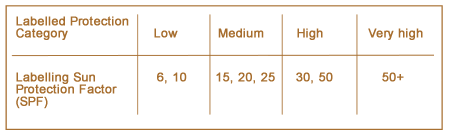
The European Commission's Recommended SPF Numbers and their Protection Categories
The science behind SPF
Everyone reacts to the sun in their own way. Some people's skin is affected more by the sun's harmful rays than others. The SPF of a sunscreen is measured by testing it in a standard way which provides an SPF number. There are different standardised methods available to companies to measure the SPF of a sunscreen product.
One of the methods involves testing the product on a range of people: the set amount of product is applied to a measured area of skin on a number of people who are exposed to a specific amount of sunlight. The reaction of their skin is then assessed.
A similar test method to the above is available to companies to measure the SPF of sunscreen products, which does not involve application on people but on a squared plate which mimics the skin surface. This method is called in vitro.
Another test method still involves applying the test product to a measured area of skin on a number of people, who are then exposed to a specific amount of monochromatic (single colour) light. The test then measures the amount of light reflected back by the sunscreen product on the skin.
But cosmetics companies don't just rely on just one test for the SPF number. During development, the product is tested by scientists a number of times to check the SPF is on track. Scientists always ensure consistent results are seen.
This robust development and testing process is what companies go through before they label their product and put it on the shelf. Therefore, we can be confident the level of protection on the pack is correct.
How do I know I am protected against UVA?
Although UVA rays do play a small role in sunburn, the main concern is that UVA rays penetrate deeper into the skin and cause damage to the cells resulting in premature skin ageing. Both UVA and UVB rays are attributed to causing skin cancers of several kinds.
 The UVA protection that a sunscreen provides will be evident on the label. In the UK and across Europe, UVA protection is indicated on-pack by showing the letters "UVA" in a circle.
The UVA logo is used throughout the UK and Europe to show that a product contains at least the recommended minimum level of UVA protection for a sunscreen.
Whilst the star system to indicate UVA protection has been effective in educating consumers in the UK, it is a commercial labelling system and not all sunscreens in the UK will carry the star rating for UVA protection and they will not be used in other European countries or across the world.
The European Commission recommends that we should always choose a sunscreen that provides both UVA and UVB protection.