


Supporting Your Child in Building Healthy Skincare Habits
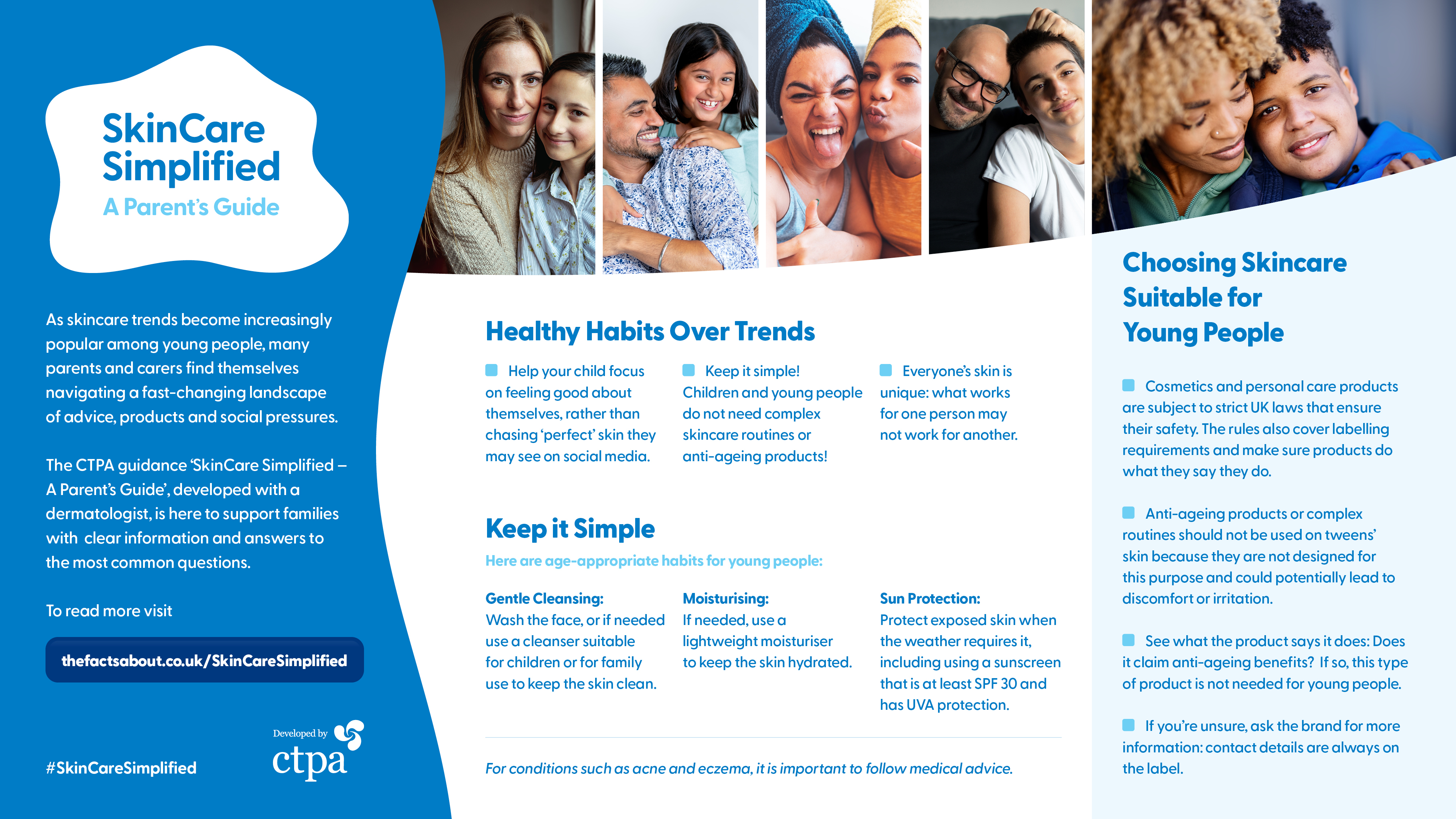
Download and share our infographic:
- Mobile phone format (ideal to share with family and friends)
- Desktop format (ideal to print or use on computer screens)
Q. How can I help my child build healthy skincare habits?
The first, and most important, point for all age groups is to help your child or teenager understand that the pursuit of perfect skin is unrealistic and unnecessary, as many images on social media are heavily edited and do not reflect reality. Encourage open conversations about the impact of social media on self-esteem and body image and promote a healthy self-image by focusing on their unique strengths and qualities. Set a positive example by embracing your own natural beauty and speaking positively about yourself and others.
Suitable skincare habits for children are simple, quick and easy to remember. A skincare routine will not give your child or teenager ‘perfect’ skin, so it is important to help them have realistic expectations and to accept their own individual skin and appearance. Keeping the skin clean; for example, by using a gentle cleanser, and if necessary, keeping dry skin hydrated with a lightweight moisturiser, will help keep skin soft, smooth and in good condition. Children don’t need moisturisers with added benefits such as anti-ageing, radiance boosting or promoting even skin tone, just a basic moisturiser is suitable.
When the weather requires it, make sure that your child is wearing a sunscreen of at least SPF 30 which protects against UVA and UVB rays. UVB protection is indicated by the SPF, and UVA protection by a symbol showing the letters ‘UVA’ in a circle. Again, a family sunscreen product should be used rather than one with added beauty benefits which is aimed at adults.
Dr. Anjali Mahto’s advice:
The most effective way to build healthy skincare habits is to keep routines simple and repeatable. A basic three-step approach — cleanse, moisturise, and apply sunscreen — forms the foundation. Overly complicated regimens are unnecessary and often unsustainable. Children learn by example, so modelling balanced habits at home is powerful: washing the face gently, moisturising daily, and using sun protection outdoors. Skincare should be framed as self-care for skin health, not a pursuit of perfection. Avoid equating “good skin” with worth or success, and instead focus on confidence, wellbeing, and self-acceptance. Encouraging realistic expectations early helps protect against the social pressures and anxieties that often emerge during the teenage years.
Q. How can I support my child’s curiosity about trying multiple skincare products?
It’s great to encourage and support lifelong healthy skin habits. Establishing good skin care habits encourages a sense of responsibility and self-care, much like brushing your teeth or eating healthily. However, there’s no need for elaborate routines or a cupboard full of products. Discussing with your child that looking after their skin is just another aspect of looking after their overall health helps build lifelong, positive habits without unnecessary complexity.
As you guide your child through their curiosity about different brands and categories, consider involving them in research and discussion about ingredients, packaging, and marketing claims. This process equips them with critical thinking skills.
For example, having an awareness of which products and ingredients are suitable for your child’s skin type and age, as they move into adulthood. This will help your child to consider whether an exciting new product is going to suit their skin type or not, and whether it is relevant for their stage in life.
Encourage your child to approach new products with patience - trying one change at a time makes it easier to notice which product works. Setting reasonable boundaries, such as waiting to finish a suitable product before buying another or choosing trial sizes, can help them learn self-discipline and mindful consumption.
When considering what’s “age-appropriate,” remind them that skincare should be about self-care, not perfection. By shifting the focus from trends to well-being and self-acceptance, you support their healthy development - both inside and out.
Q. My child wants to copy 10-step routines they have seen on social media. How do I handle this?
 Encourage open conversations about the impact of social media on self-esteem and body image and promote a healthy self-image by focusing on their unique strengths and qualities
Help your child understand that the pursuit of perfect skin is unrealistic and unnecessary. Encourage them to have realistic expectations and to accept their own individual skin and appearance.
The basics of cleansing, moisturising and UV protection are enough habits to start with.
Keeping the skin clean; for example, by using a gentle cleanser, and if necessary, keeping dry skin hydrated with a lightweight moisturiser, will help keep skin soft, smooth and in good condition. Children don’t need moisturisers with added benefits such as anti-ageing, radiance boosting or promoting even skin tone, just a basic moisturiser is suitable.
When in the sun, make sure that your child is wearing a sunscreen of at least SPF 30 which protects against UVA and UVB rays. UVB protection is indicated by the SPF, and UVA protection by a symbol showing the letters ‘UVA’ in a circle. Again, a family sunscreen product should be used rather than one with added beauty benefits which is aimed at adults.
Dr. Anjali Mahto’s advice:
Multi-step routines popularised on social media may be entertaining but are not necessary for healthy skin. Too many products layered together can overwhelm the skin, increase the chance of irritation, and are often unsustainable. The basics - cleanse, moisturise, and protect with SPF 30-50 - are sufficient for almost all children and teenagers. Parents should acknowledge curiosity without dismissing it, but guide children back to the principle that more products do not mean better results. Framing skincare as health-focused self-care rather than appearance-focused perfection helps buffer against social media pressures and supports long-term, healthy attitudes to skin.
More resources on navigating social media pressure and self image can be found in the Additional Resources section.
Q. How can I answer my child’s questions about my own skincare habits?
Dr. Anjali Mahto’s advice:
 Children are observant and often want to copy adult behaviour. When discussing your own skincare, explain that adults sometimes use products that are not suitable for children because adult skin has different needs. For example, anti-ageing products are designed to address changes that only occur later in life. Be transparent about why you use certain products, but emphasise that the foundations of skincare, cleansing, moisturising, and sun protection, are the same at every age. This distinction reassures children that their simpler routine is appropriate, while helping them understand that product choice should always reflect skin type, age, and need.
Dr Anjali Mahto
Consultant Dermatologist